Technical support from 08:00 - 17:00 mon-fri
Free delivery on all orders exceeding £100
Next day delivery with selected 'priority shipping'


Technical support from 08:00 - 17:00 mon-fri
Free delivery on all orders exceeding £100
Next day delivery with selected 'priority shipping'
During this blog post, we’re going to be exploring the inner workings of Microphone Pick-Up (or Polar) Patterns, including their applications. Last week, we highlighted several microphones that are now universally in use, as well as discussing the associated benefits. First and foremost, the most obvious choice for anyone browser-surfing microphones is to select one that covers a specific pick-up pattern, as you’re most likely going to need a mic that suits the tonal requirements of the application. In turn, we feel it’s best to cover each pattern, so you’re fully clued up before purchasing.
Fortunately, as a bonus, many major manufacturers now offer microphones that allow you to select individual pick-up patterns at the flick of a switch. So, don’t be alarmed if your microphone isn’t working entirely as intended, there’s always a solution!
Omnidirectional
If you’ve heard of the term omnidirectional microphone you may be wondering what it’s all about? Basically, the word ‘omni’ is a Latin prefix originating from the word omnis, meaning ‘all’ or ‘every’ – so in the term omnidirectional, we can deduce that the microphone will pick up sound equally from every direction.
Whilst omnidirectional microphones have their uses, and are employed in vast applications around the world, you still need to appreciate their capabilities and ensure correct placement. As they can pick up sound from all directions, the chances of inducing unwanted noise into your feed is greatly increased, therefore resulting in feedback (this is something to look out for). Despite this, they are superb for picking up ambient noise in an open space, and can also be used for Induction Loop Systems to ensure the hard of hearing are included in the atmosphere of a room, instead of being fed the main source material.
All microphones start out their lives as omnidirectional, and with applied techniques and constructive methods, engineers are able to manipulate and shape alternative pick-up patterns. Namely cardioid, another well known polar pattern. Supercardioid can be included within this statement too. If we were to look at a diagrammatic representation of an omnidirectional microphone, we’d quickly notice the ‘head’ of the mic would remain fairly static with moderate frequencies. It isn’t until we introduce higher frequencies that directionality inevitably kicks in.
Unidirectional
Unidirectional microphones differ slightly in their usage in comparison to omnidirectional. That being, they are strictly designed to pick up sound sources from one singular direction, generally the front, whilst rejecting sound from other angles.
Microphones of this nature are often categorised into types:
Unidirectional mics are also used in various settings, due to their unique and sought-after capabilities:
Ultradirectional
Up next, we have the most directional form of the previous two pick-up patterns; Ultradirectional. These microphones are highly directional and more aggressively attuned to capture sound from an incredibly narrow angle (more so than omnidirectional and unidirectional), whilst also being able to simultaneously reject sound from the sides and rear.
Ultradirectional microphones are engineered to achieve maximum directionality using specialised acoustic and physical design techniques. The most common implementation is the shotgun microphone, which I’m sure you’ve seen a handful of times on the news when a camera pans to a journalist out in the field.
As a company that specialises in microphones, among other things, the construction of ultradirectional microphones is quite fascinating. Particularly, how they differ from your typical omni/uni-directional patterns.
The key characteristics of any ultradirectional microphone include:
Besides the fundamental design of an ultradirectional mic, there are also a multitude of uses:
There are also a few other types of microphones that we haven’t touched on, and they include:
Parabolic
Parabolic Microphones get their name from a Parabolic Reflector, which is used to collect and focus sound waves onto a transducer. They work by using a dish-shaped reflector to focus sound onto a microphone placed at its focal point. Microphones of this nature are oftentimes used in nature recording and sports.
Line Array
Line Array Microphones achieve an ultradirectional polar pattern (sometimes referred to as a lobar or superdirective pattern) through acoustic interference and beamforming principles. Beamforming may sound like a fairly fancy name, but it’s actually quite straightforward. Effectively, the technique consists of creating a signal processor that directs a highly powerful ‘beam’ in a specified direction.
Cardioid
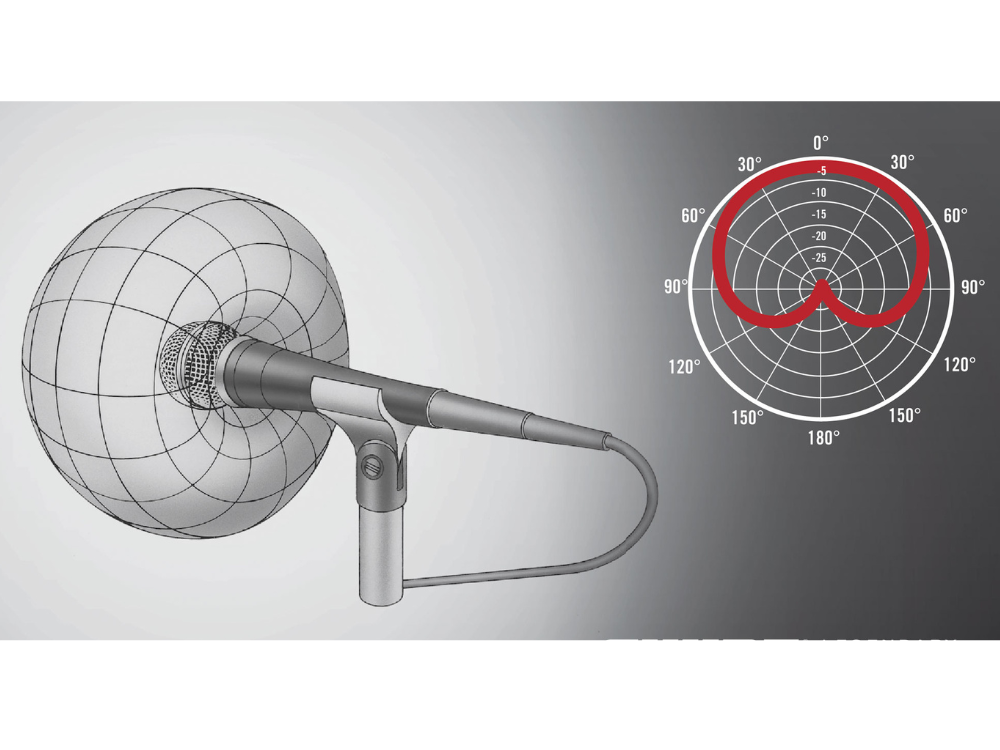
Microphones that have a pickup pattern referred to as cardioid are superb for picking up sound directly in front of them, while simultaneously rejecting noise from the sides and rear. This can occasionally be referred to as ‘unidirectional’, which we’ve covered previously on this blog post.
The shape of this pickup pattern is rather unique, in the sense that it resembles a heart. Fun fact: If we take a brief look at the etymology of the word Cardioid, you’ll notice the Greek word Kardia, meaning heart. This was first introduced in the mid 18th century, around 1714, by Giles de Roberval, and amongst other mathematicians at a later date, such as Jacob Bernoulli, to describe a type of epicycloid (rolling curve).
Ideal use cases for this pick-up pattern include spaces where you need ambient noise to be rejected from the mix. However, when using cardioid microphones, it’s wise to account for, cue the drum roll… The Proximity Effect! This effect essentially refers to an increase in low-frequency (bass) response that occurs when a sound source gets very close to a directional microphone, e.g. cardioid. hypercardioid, or supercardioid. Of course, this can be overcome by ensuring correct microphone technique is used.
There are also a handful of tips & tricks you can utilise if you’re looking to solve the proximity effect. They comprise of:
Hypercardioid
First comes Cardioid, then Hypercardioid.
A hypercardioid polar pattern is fairly similar to a supercardioid, but boasts an even narrower front pick-up angle. This can be employed beneficially if you are trying to filter out unwanted noise or control feedback in an acoustic environment. But, there are downsides too, which occur because of the angle. To counteract this, you’ll need to ensure that a disciplined microphone technique is established so that the user’s speech is perfectly directed towards the pick-up pattern angle. It may take some getting used to, but once mastered, you’ll notice the benefits almost immediately.
As with all polar patterns, there are distinct characteristics to be mindful of, as they’ll alter the effect you’re looking for. With hypercardioid, it’s best to remember the front focus, which is excellent at oscillating sound sources directly in front of it. Beyond that, there is side rejection, which strongly attenuates sound from all sides, making it an ideal choice for those noisy or even acoustically reflective environments. Lastly, there is the rear lobe, with minimal pickup at the rear (~15 dB lower than in front).
Why exactly is hypercardioid preferred in many settings worldwide?
For one, it grants you ‘better isolation’, which is useful in applications where you want to capture a single sound source such as vocals or instruments, as well as rejecting background noise.
Another reason may be due to the ‘feedback resistance’ it offers, often chosen in live sound reinforcement because of its tight focus. In turn, reducing the chances of an end-user picking up monitors or PA speakers.
Thirdly, we have ‘controlled ambience’ – in film/TV production, equipment capable of producing a hypercardioid polar pattern are efficient at picking up clear dialogue and minimising reverberation from outside sources.
Being just around the corner, you can appreciate these companies are trying to get you ahead of the game. However, they can overlook that within businesses, telephones are often linked to Public Address, or Tannoy Systems. Needless to say, in many respects the digital world offers superb flexibility and many benefits compared to the old analogue world. Unfortunately, newer digital telephony devices usually aren’t natively compatible with sound systems like the trusty analogue systems were.
Supercardioid
So, we’ve delved into Cardioid and Hypercardioid, but there’s still one more cardioid-derived pattern to consider. Supercardioid. If you’re wondering what each pick-up pattern means in layman’s terms, we would classify each as a reflection of increasing directionality. To simplify things, we’ll include an arrow diagram below:
Cardioid → Supercardioid → Hypercardioid (least directional (heart-shaped) → more directional → most directional).
An interesting thing to note about the Supercardioid Pick-Up Pattern, is that it has an extra rear lobe pick-up capability with a generally tighter forward pick-up angle than the standard cardioid. You will need to be extra careful when positioning these microphones, ensuring the rear lobe of sensitivity doesn’t pick up unwanted ambient noise. Ultimately, incorrect positioning of supercardioid microphones also increase the potential for feedback to be induced as the feed from stage monitors or other loudspeakers can gradually sneak back in. It’s far easier to prevent this from occuring than trying to remedy it after it’s already happened. As the old proverb goes, an ounce of prevention is worth a pound of cure.
Upon inspection of the image displayed below, we’re going to be briefly discussing the bottom left pick-up angle, which belongs to a supercardioid microphone. You’ll notice straight away the pick-up angle of the supercardioid is tighter than the top right, belonging to your traditional cardioid. This is most obvious at the centre
If you’re looking for an easy way to distinguish a cardioid from a supercardioid, just look for the one that resembles an upside down heart. It’s easily the most distinguishable for users first learning pick-up patterns. As for the supercardioid, you should also be able to see this extra lobe of activity round the lower half (or rear), which simply isn’t there in a standard cardioid pattern. So, as with most things, you have to find a compromise when choosing the ideal pattern for your specific application. This is especially true when microphone polar patterns are concerned.
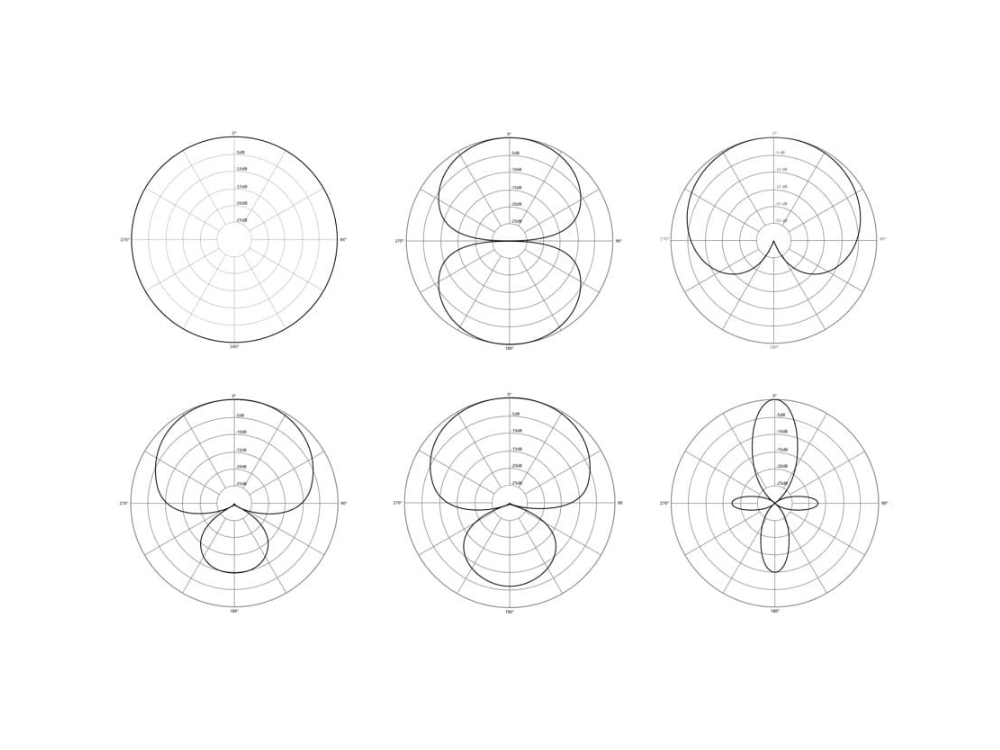
Figure-8
Even though omnidirectional and cardioid pick-up patterns are most widely used, there are other patterns out there that offer several advantages and uses throughout the broadcasting and recording world…
One such pattern is designated, Figure-8. This particular pattern is capable of picking up audio from both the front and back, as well as being able to reject noise from either side. This ability to equally pick up sound sources from forward-facing and rear-facing angles is often referred to as ‘bi-directional’.
Figure-8 may be the easiest pattern to recognise besides cardioid for anyone who’s stumbled across this blog post, and that’s because you only need to look for a diagram that resembles the number 8. This is where the microphone head is situated and the lines of the ‘8’ cross over one another. For reference, it will look slightly similar to an infinity sign ∞, but placed vertically instead of horizontally.
Additonally, the figure-8 pattern can be used to record two sources at the same time, albeit two voices from people speaking. With careful positioning, this pattern could very well be the answer to a lot of solo artists needs, as it can be utilised to pick up both singing, and guitar audio, without inadvertently picking up sound sources from the audience. However, there’s always things to consider — improper application can result in poor audio quality. One such scenario might include the use of a figure-8 polar pattern instead of a cardioid, greatly causing the audio from the rear of the microphone to be fed into a broadcast or recording. Ultimately, these are options to weigh up and consider depending on your setting or application.
Shotgun (Lobar)
The final polar pattern we’re going to be discussing today is simply Lobar, or Shotgun. Perhaps the most highly-used pattern in the filming and broadcasting industries in the form of a shotgun microphone. It’s most distinct feature is the shape, which features a narrow lobe at the front and smaller, less sensitive lobes at either side. See bottom right on the above diagram*.
This gives it more directionality than even a hypercardioid or supercardioid pick-up pattern. Usages for this type of microphone pattern are numerous, with the majority most commonly found in shotgun mics, capable of capturing audio from a distance, i.e. film, theatre, wildlife recording, TV, and so on. One of the more interesting aspects of a lobar pattern is its design; which is achieved via an interference tube placed in front of a microphone diaphragm, thereby cancelling sound that arrives off-axis.
The Lobar polar pattern, like many others, offers significant advantages, particularly for those who have a vested interest in professional audio where focused sound capture is needed.
In all, we’ve covered a total of eight pick-up patterns, ranging from omnidirectional to cardiod to lobar, as well as detailing their characteristics, benefits, and potential areas to look out for. Not to mention, providing information that should allow you to better understand microphone polar patterns, and how to effectively choose equipment that complements them.