Technical support from 08:00 - 17:00 mon-fri
Free delivery on all orders exceeding £100
Next day delivery with selected 'priority shipping'


Technical support from 08:00 - 17:00 mon-fri
Free delivery on all orders exceeding £100
Next day delivery with selected 'priority shipping'

During this blog post, we’re going to be taking an in-depth look at a variety of different microphones that have stood the test of time, in addition to some that have garnered attention and praise through the early 21st century, and beyond. As with almost all technological advancements in the modern era, microphones have managed to develop in conjunction — offering significant advancements the world over.
These particular strides in progress have been driven by improvements in material acquisition, miniaturisation, digital signal processing (DSP), and of course, more recently, digital integration with smart devices. Current-day microphones play a critical role in virtually every domain of modern life; their ability to capture sound clearly and accurately makes them indispensable for communication, creativity, safety, and productivity, to name a few.
Now, if we were to list every single microphone that’s available on the market today, we may be here a while. Instead, we’ll focus on highlighting a handful of microphones that have experienced continued technological growth… as well as some that paved the way during the early 20th century!
A Lavalier Microphone (synonymously referred to as lapel mic) is a small, clip-on microphone predominantly designed for hands-free operation. For almost all versions of microphones, placement is paramount. This is even more relevant when lapel microphones are concerned. Aside from placement, the size of a mic is also equally important as it needs to function effectively while remaining discreetly clipped to the user’s clothing (typically a collar, lapel, or tie), and not too far a distance from the speaker’s mouth.
Usages vary in the world of acoustic performance. However, lavalier mics tend to function effectively in applications involving television, theatre, public speaking, filmmaking, and even live performances, where crystal-clear unobtrusive audio capture is required.
There are two distinct types of lavalier microphones widely supplied nowadays, and they comprise both Wired and Wireless. With Wired, they’re directly connected to a recording device or transmitter. On the other hand, the use of a Wireless Microphone requires connection via a bodypack transmitter, offering freedom of movement in comparison to the wired version, which is oftentimes restrictive in its ability to be freely moved.
In regards to Pick-Up Patterns, Lavalier Microphones utilise an omnidirectional polar pattern. The reasons for this are:
The birth of Ribbon Microphones came into fruition slightly over a century ago, in early 1924. From then until 1928, the concept of using a metallic ribbon suspended in a magnetic field was theorised and developed by both Dr. Walter H. Schottky and Dr. Erwin Gerlach. As a result, this led to the proposed basis for the ‘ribbon transducer’.
Several years later, the original concept of ribbon microphones gained significant traction. Whereby, in 1931, the first commercially successful product: RCA PB-31, was introduced by RCA (Radio Corporation of America) engineers Harry F. Olson and George P. Simon. This model laid the groundwork for the majority of modern Ribbon Mics. Interestingly enough, Harry F. Olson was a pioneer in the world of Sound & Applied Acoustics. As development of Ribbon Microphones progressed, the Radio Corporation of America hit the ground running and later released the 44-A in 1933. This quickly became an iconic piece of history in radio broadcasting and music recording during the 1930s, known for its smooth frequency response and natural sound reproduction.
Thanks to modern manufacturing techniques, the latest ribbon microphones aren’t as delicate as the originals, thus allowing them to make a steady comeback. 100 years on from their inception, they can now be found replacing both condenser and dynamic microphones for a variety of applications; but how exactly do they work and what are their benefits? The basic construction of a ribbon microphone comprises a metal film, called the ribbon, suspended between the poles of a fixed magnet. As the air from the audio source hits the ribbon, it moves within the magnetic field and subsequently induces a voltage into the ribbon which is picked up as the audio feed.
In the early-to-mid 1900s, this voltage was so small that transformers were often used to boost the signal. These aren’t miniature robots that turn into cars of course, but rather small electrical transformers that provided a simple means of stepping up voltages. Modern day magnets are powerful enough to negate the need for these transformers — especially in some of the latest models.
It is also worth mentioning that checking the specification of your microphone will ensure you’re not affected by the presence of phantom power. Some antiquated Ribbon Microphones can potentially be damaged by phantom power voltages, whereas other modernised products may indeed need phantom power to function! One final note to add to your memory banks is the requirement for correct storage of ribbon microphones, as storing them lying flat can occasionally cause the internal ribbon to droop slightly, resulting in damage or performance degradation.
Condenser Microphones are similar to Ribbon Microphones in the fact they both have a storied, and rich history. If we cast our minds back to the mid 1910’s, in particular, the 20th of December 1916, we’ll have soon heard the news of a sweeping invention that revolutionised the way telephone audio transmission was received. That being the Condenser (Capacitor) Microphone, invented by E.C. Wente, an engineer at Western Electric in the United States. The original concept of Condensers were to improve the audio transmission of telephony, but E.C Wente later found it valuable for high-fidelity sound recording.
The mechanical operation of a condenser microphone consists primarily of a thin diaphragm stretched across and closely positioned next to a fixed metal disk. This metal disk is often referred to as the ‘back plate’. Specific materials combined with the closeness of each surface creates a capacitor. When the diaphragm is vibrated by sound waves, the capacitance varies, causing a change in voltage. Essentially, this is the microphone signal that gets sent to a mixer and/or amplifier for further processing.
Another noteworthy fact about condensers is that they contain additional circuitry to allow them to function, which requires power. This can be supplied from a battery or indeed, a phantom power source. In a handheld microphone, the battery is likely located within the body, but with a tie-clip or headset solution, there may be a separate power supply attached to or with a belt-clip. The general use of condensers utilise something called ‘Phantom Power’. Relatedly, we have an entire Blog Post dedicated to Phantom Power, if you wish to learn more.
So, what benefits do condenser microphones offer? Well, they possess several advantages over the traditional (typically Dynamic Microphones), making them popular in studio and high-fidelity recording settings.
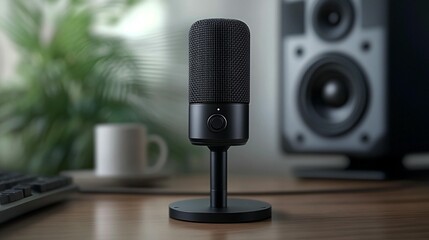
If you’re looking for a quick and easy way to set up microphones that link to a PC, iMac, or other computer then a USB Microphone may be the solution. Fundamentally, a USB microphone is a standard microphone that has been aptly developed and designed to plug directly into your PC via a USB connection. Microphones of this nature will comprise of all the parts common to standard microphones, with the exception of built-in electronic circuits that function as pre-amplifiers and power supplies. Specifically, to allow the output from your mic to be sent to your computer.
To the unassuming eye, USB microphones may seem more or less the same, but they’re actually fairly multifaceted. As such, there are a multitude available on the market, ranging from dynamic handheld devices to ‘studio-style’ condensers.
Although they are extremely handy and straightforward to set up, there are some downsides to consider. Generally, if you only require a single mic for occasional webcasting or home use, then a USB mic is an ideal place to start. However, if you’re looking into having multiple microphones that must be mixed together or interconnected, then you may encounter a few obstacles.
Fortunately, there are solutions that allow you to use a conventional XLR Microphone, while also being able to connect to a computer. Small interface boxes can provide your condenser microphones with the necessary phantom power and then provide a USB output for connection to the computer. These are an excellent means of using various microphones without being affected by a single fixed-lead USB mic. Mixers can also be utilised to allow several conventional microphones to be plugged in, just as they would in your typical stage or recording environment.
In addition to this, using a USB microphone offers several advantages, especially for aspiring creators, podcasters, streamers, and home studio users:
Next up, we have Dynamic Microphones.
In essence, dynamic microphones work by creating an audio signal via the use of an electrical conductor being passed through a magnetic field, which is then induced into that conductor. They’re quite possibly the most far-reaching and durable types of microphones in operation today, and are widely used in live sound and studio recording applications.
The commonplace dynamic microphone you’ll find on the market today uses a moving coil to create the audio signal. If you were to disassemble a moving coil microphone, you’ll notice a very thin membrane that picks up vibrations in the air from an audio source; whether that be vocal, or from the sound of an instrument. The membrane itself is attached to the coil, so naturally, when the membrane moves, as does the coil too. A fascinating aspect of dynamic microphone coils is that they’re surrounded by a permanent magnet, so as they move within the magnetic field, a required electrical current is produced. This electrical current is then transmitted to the audio mixer or amplifier. In which case, it will be amplified.
Another fascinating aspect of dynamic ‘moving coil’ microphones, is that they do not need any additional external power, with the majority featuring typically sturdy and robust materials. This places them as a preferred choice for stage use. Generally, they aren’t as sensitive as other types of microphones and can normally withstand a fair amount of strain; making them an ideal candidate for applications that involve, or require high levels of sound. More often than not, they’re less sensitive to higher frequencies, so if you don’t need pitch-perfect frequency pick up in your audio capture then a dynamic microphone is the way to go.
We’ve briefly recounted the history of several prominent microphones dating back to their early origin, up until modern-day 21st century, including lavalier, ribbon, condenser, USB, and dynamic. As well as highlighting the different advantages they offer, and proposed usages. We’ve also discussed some of our personal insights and knowledge on having personally supplied and used a variety of the microphones in question.